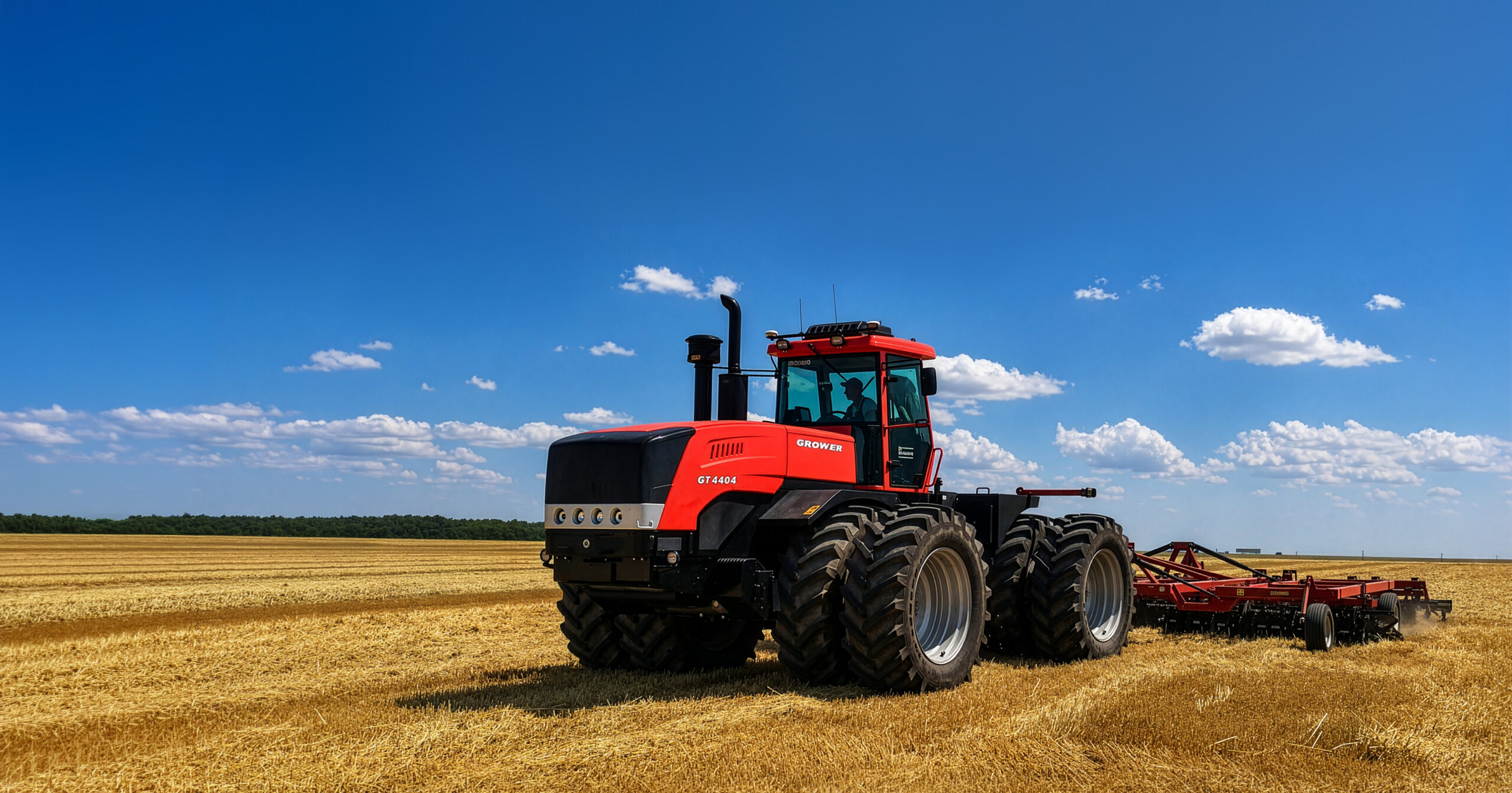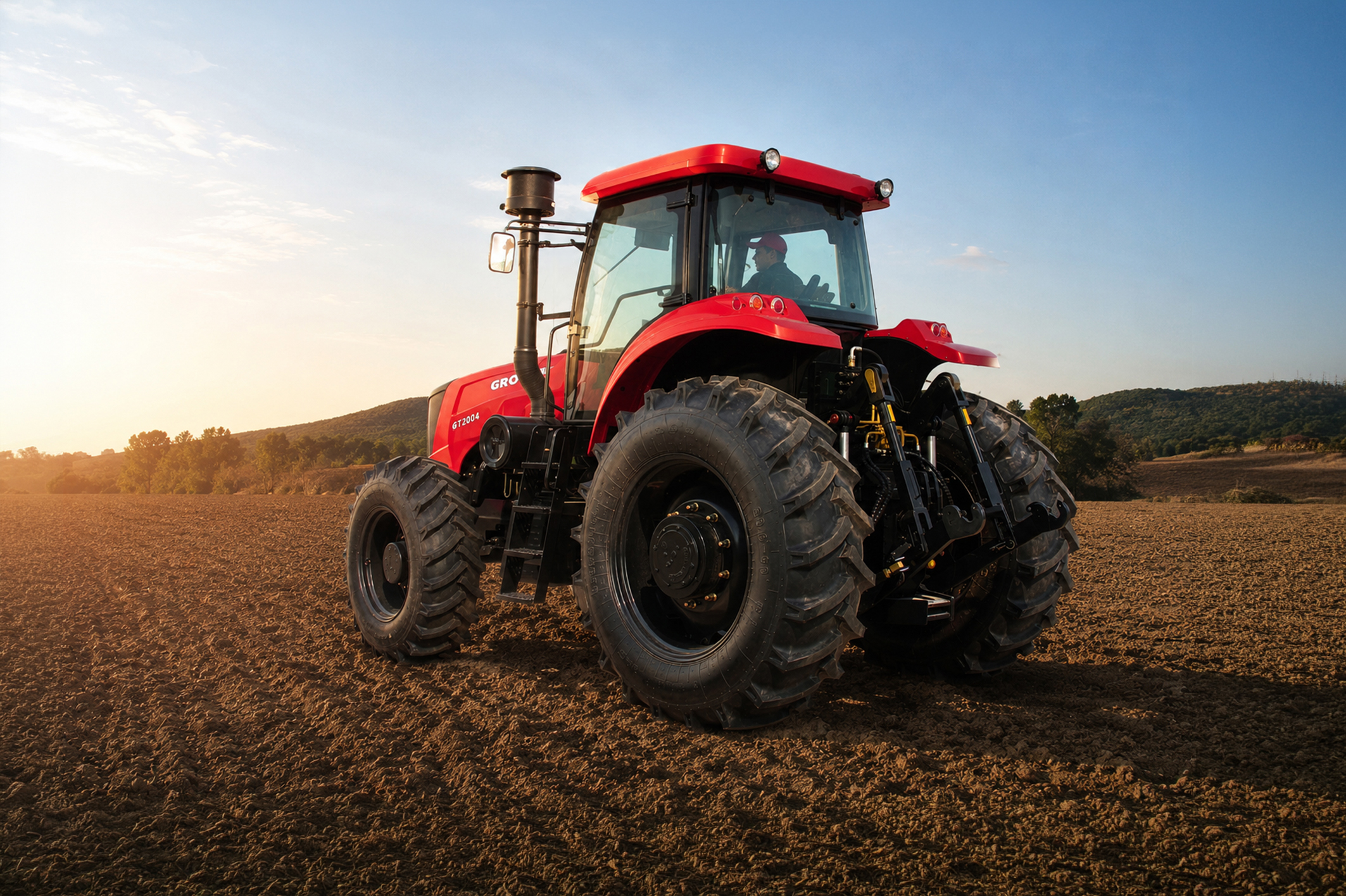

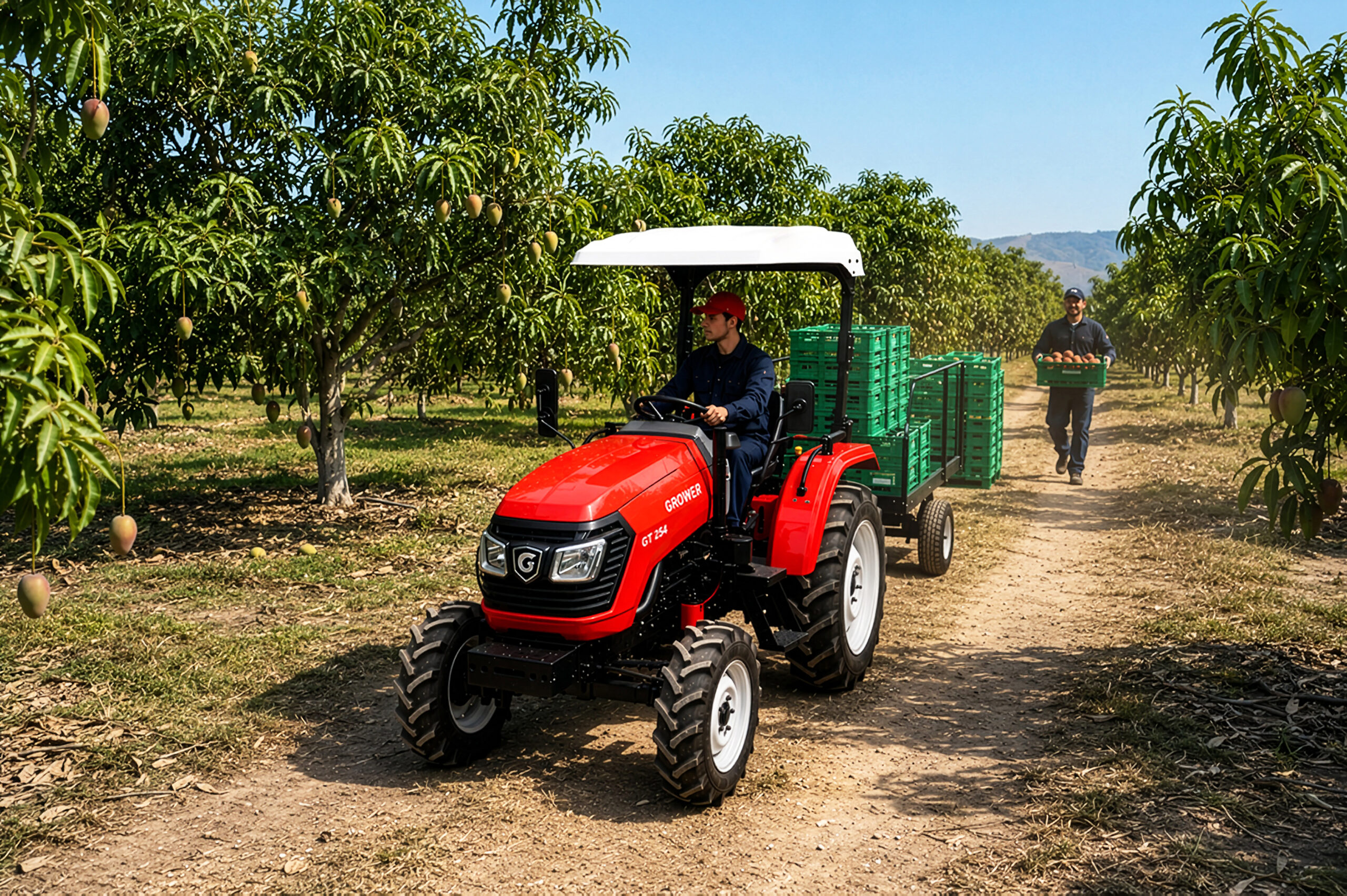
How the GT 254, GT 354, GT 454 and GT 504 are positioning GROWER as a homegrown challenger in the global compact tractor market
The compact and utility tractor segment — machines generally rated between 25 and 50 horsepower — has long been dominated by a handful of international names: John Deere, Massey Ferguson, Kubota, New Holland, Case IH, Valtra, Deutz-Fahr, LS Tractor, Solis and Mahindra all compete for the attention of small-acreage farmers, orchardists and municipal buyers. Entering this well-established market is GROWER, an American agricultural machinery brand building its identity around a clear value proposition: American-built equipment designed to meet the real-world needs of small-, medium-, and large-scale agriculture.
GROWER’s Range 25–50 HP — comprising the GT 254, GT 354, GT 454 and GT 504 models — is the company’s entry point into that market, and it illustrates a broader trend in the industry: compact tractors are no longer a stripped-down afterthought to full-size row-crop machines. They are increasingly engineered products in their own right, aimed at orchards, vineyards, horticultural operations, hobby farms and livestock outfits that need real lifting capacity and PTO power without the footprint of a full-size tractor.
What Is the GROWER Range 25–50 HP?
The GROWER Range 25–50 HP is a four-model lineup — GT 254, GT 354, GT 454 and GT 504 — spanning roughly 25 to 50 engine horsepower. All four share a common design philosophy: a compact chassis with four-wheel drive, an 8-speed forward/2-speed reverse gearbox, full hydraulic steering and a rear three-point hitch rated Category I and II, wrapped around engines sized to match each model’s intended workload.
According to GROWER’s published specifications, the range is built to work in confined spaces, specialized crops and maintenance operations while holding up under sustained daily use — a description that echoes what compact-tractor buyers across the industry have come to expect, whether they’re shopping GROWER or one of the established international brands.
Where the range differentiates itself is in scalability. Rather than offering a single horsepower point, GROWER lets a buyer step up from a 24.6 hp entry model to a 49.3 hp flagship without leaving the same basic transmission and hitch architecture, which simplifies parts, service training and implement compatibility across a fleet.
GT 254 — The Entry Point
The GT 254 is the smallest model in the range, powered by a GROWER GE-LD254 inline four-cylinder, water-cooled, naturally aspirated engine displacing 1.6 liters (1,600 cc). It is rated at 18.4 kW (24.6 hp) at 2,350 rpm, with a PTO output of 34.38 kW (46.1 hp). A 40-liter (10.6-gallon) fuel tank and a minimum operating weight of 1,250 kg (2,755 lb) with cab round out a package designed for growers who need a genuinely small, maneuverable machine.
GT 354 — Mid-Range Versatility
The GT 354 steps up to a 2.24-liter (2,240 cc) version of the same four-cylinder architecture, rated at 25.8 kW (34.5 hp) at 2,400 rpm. It shares the GT 254’s transmission, hydraulic layout and 40-liter fuel tank, making it a natural upgrade path for operations that have outgrown the entry model’s power ceiling but still need a compact footprint.
GT 454 — Added Displacement and Fuel Capacity
The GT 454 uses a larger 2.55-liter (2,550 cc) engine producing 33.1 kW (44.4 hp) at 2,400 rpm, paired with a larger 55-liter (14.5-gallon) fuel tank and a slightly heavier 1,380 kg (3,042 lb) operating weight. This model is positioned for buyers who want more sustained pulling power for tillage, mowing or loader work without moving into a different chassis class.
GT 504 — The Flagship, With Turbocharging
At the top of the range, the GT 504 is the only model in the series equipped with a turbocharged, intercooled, direct-injection engine — a 2.9-liter (2,900 cc) four-cylinder rated at 36.8 kW (49.3 hp) at 2,400 rpm. It also carries a noticeably larger frame, with a minimum operating weight of 2,120 kg (4,673 lb) and a wheelbase of 2,035 mm (80 in), roughly 300 mm longer than the GT 254 through GT 454. The GT 504 is built for operators who need close to 50 hp of usable power while staying inside the compact-tractor category.
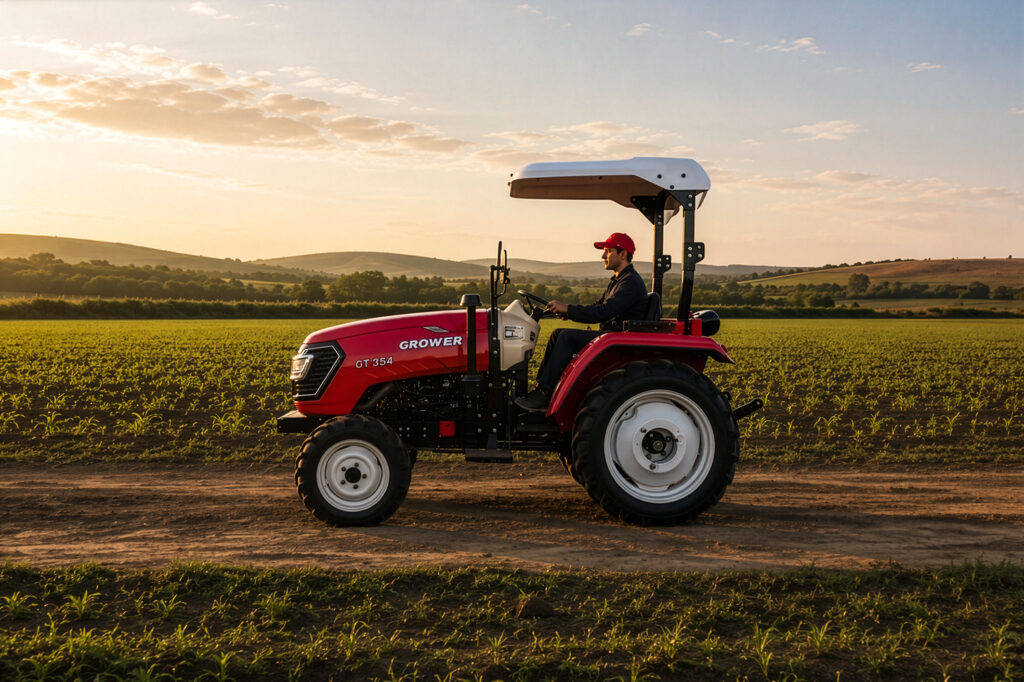
Engineering Details: Transmission, PTO and Hydraulics Across the Range
One of the more notable aspects of the GROWER Range 25–50 HP is how much of the drivetrain and control architecture is standardized across all four models, which simplifies both operation and long-term maintenance for growers running mixed fleets.
Transmission. Every model in the range uses four-wheel drive (4WD/4×4) paired with an 8-speed forward, 2-speed reverse (F8+R2) gearbox, delivering a maximum forward speed of 27.2 km/h (16.9 mph) — enough for road transport between fields without sacrificing the low-speed control needed for precision fieldwork.
PTO (Power Take-Off). All four tractors are equipped with a rear-mounted, independent PTO offering selectable 540/760 or 540/1000 rpm speeds, run through an 8-spline shaft (6-spline optional). That dual-speed flexibility lets a single tractor drive both slower-turning implements, such as certain rotary tillers, and higher-speed attachments like some mowers and shredders, without swapping equipment.
Hydraulic system. The standard configuration includes two pairs of hydraulic outlets with height control and float control as part of the draft-control system; a three-outlet configuration is available as an option. Combined with the Category I/II rear three-point hitch, the range is built to run a broad spectrum of three-point implements, from box blades and post-hole diggers to rotary cutters and small disc harrows.
Steering and hitch. Full hydraulic power steering is standard across the line, which matters in orchard rows, vineyard aisles and other tight-clearance environments where an operator may be turning the wheel dozens of times per hour.
Traction and lift. GROWER lists a maximum traction force of 18.85 kN (4,237.65 lbf) and a maximum lifting force of 725 kg (1,600 lb) across the range — figures that determine how much implement weight a given model can safely lift and hold on the three-point hitch during fieldwork.
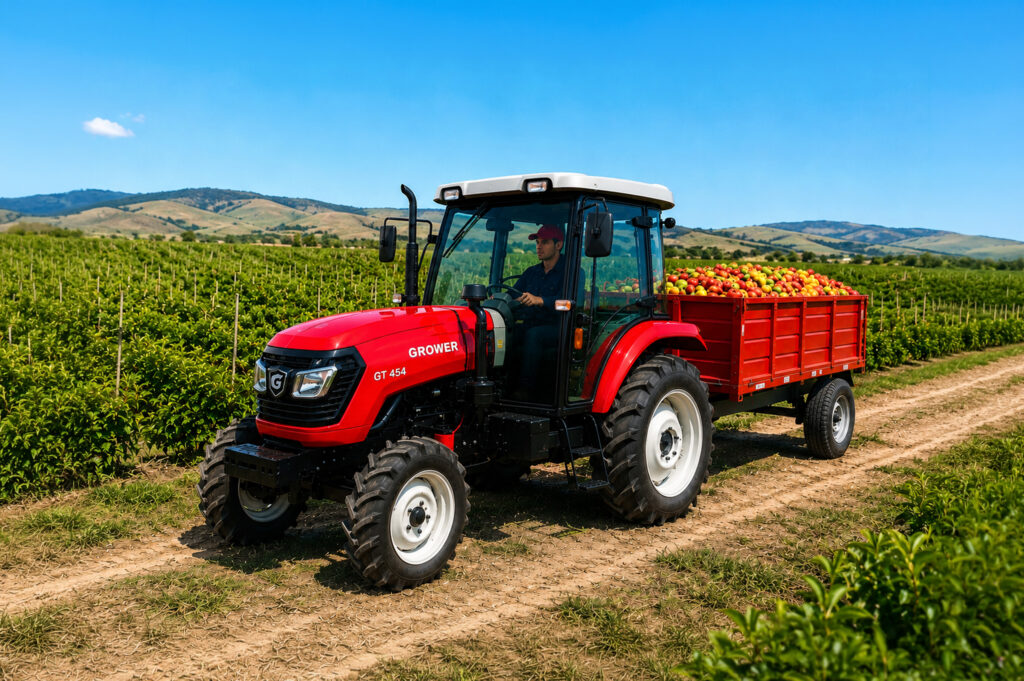
Built for Orchards, Vineyards, Horticulture and Livestock Operations
Compact tractors in the 25–50 HP window exist because a large share of real-world agricultural work simply doesn’t require — or fit — a full-size row-crop tractor. GROWER’s Range 25–50 HP is aimed squarely at that reality.
Orchards and vineyards. The combination of a tight wheelbase (1,730 mm on the GT 254, GT 354 and GT 454), adjustable front and rear track widths, and full hydraulic steering makes the range relevant to growers working between narrow tree or vine rows, where a wider utility tractor simply won’t clear the canopy or the row spacing.
Horticulture and specialty crops. The dual-speed PTO and two-pair hydraulic system give horticultural operations the flexibility to run cultivation, spraying and mowing implements from the same base machine, which matters for smaller specialty-crop farms that can’t justify a dedicated tractor for every task.
Livestock operations. With lifting capacities suited to small square balers, loaders and manure-handling attachments, the GT 354 and GT 454 in particular sit in a horsepower range commonly used for feeding, bedding and general chore work on cattle, dairy and equine operations.
Municipal and grounds maintenance. GROWER’s own materials note applications beyond production agriculture, including maintenance and municipal work — a use case shared with most compact tractor lines in this horsepower class, where mowing, snow removal and light grading are common tasks.
Operator Comfort, Everyday Reliability and Cost of Ownership
Beyond raw specifications, GROWER positions the Range 25–50 HP around everyday usability. The lineup is available with a cab configuration, and GROWER’s optional package adds air conditioning, a third pair of hydraulic outlets, and front and rear iron ballast — additions aimed at operators who spend long hours in the seat across multiple seasons rather than occasional use.
Maintenance considerations also matter to buyers in this segment. A naturally aspirated four-cylinder engine, as used in the GT 254, GT 354 and GT 454, is generally regarded across the industry as mechanically simpler to service than a turbocharged, intercooled unit like the GT 504’s engine — a trade-off worth weighing against the extra power the GT 504 provides. Fuel tank sizing also scales with the range: 40 liters on the three smaller models and 55 liters on the GT 454 and GT 504, giving the larger machines correspondingly longer run times between refueling.
For return on investment, the calculation for compact tractors in this class typically comes down to how many implements a single machine can run and how much of the farm’s task list it can absorb. A standardized 3-point hitch, dual-speed PTO and two-to-three hydraulic outlets — all standard or available across the GROWER range — are the features that determine implement compatibility, and by extension, how much of a farm’s equipment budget can be consolidated into one machine rather than several specialized ones.
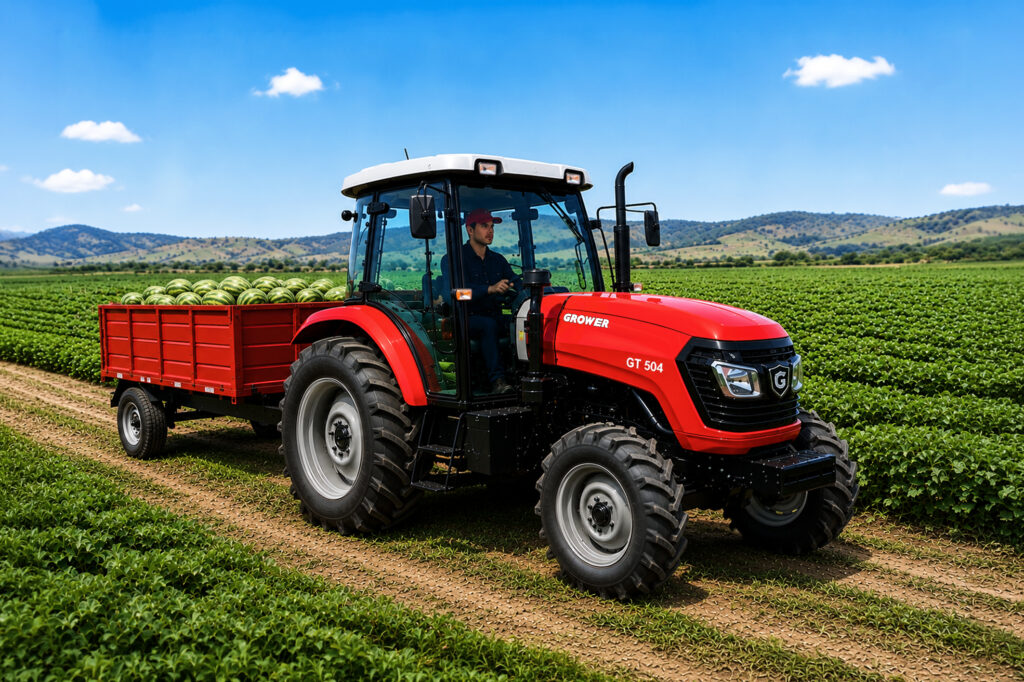
GROWER’s American Manufacturing Identity in a Global Market
GROWER identifies itself as a U.S.-based agricultural machinery brand, headquartered in Miami, Florida. Its marketing materials feature the “I Make America” emblem, reflecting the company’s positioning within the broader U.S. manufacturing narrative. This positioning emphasizes GROWER’s connection to the domestic agricultural machinery market and distinguishes the brand within an industry that includes numerous multinational manufacturers.
That positioning places GROWER in direct contrast — geographically and rhetorically — with a compact tractor market where several of the most recognized names manufacture core products overseas or through multinational parent companies. John Deere remains the volume leader across nearly every tractor horsepower class in North America. Massey Ferguson, a brand of AGCO, recently refreshed its own compact tractor lineup — spanning roughly 20 to 65 hp — with new styling and cab updates across its 1E, 2E, 1M and 2M series. Kubota built much of its U.S. market share specifically in the sub-60-hp compact segment. New Holland, Case IH, Valtra and Deutz-Fahr round out a field of established, well-capitalized competitors, each with decades of dealer network infrastructure already in place.
For GROWER, competing in that environment means leaning on specifics buyers can verify: published horsepower, displacement, PTO speeds, hydraulic outlet counts and lift capacities, all sourced directly from its own technical documentation rather than marketing claims about outperforming any single competitor. Whether that data-forward, U.S.-based approach translates into meaningful share of the compact tractor market will depend, as it does for any manufacturer in this segment, on dealer support, parts availability and real-world durability over time — factors that typically take several seasons of field use to establish. Buyers researching the segment can also consult resources like the USDA’s Farm Machinery and Equipment data for broader context on the U.S. small-farm equipment market, or the equipment safety guidance published by OSHA for standards relevant to any compact tractor purchase.
Implements and Practical Applications
Because the GROWER Range 25–50 HP standardizes around a Category I/II three-point hitch and a dual-speed 540/760 or 540/1000 rpm PTO, it is compatible with the same broad implement categories used across the compact tractor segment generally: rotary tillers, box blades, rear blades, post-hole diggers, rotary cutters and mowers, small disc harrows, seeders, sprayers, and front-end loaders where the buyer specifies front linkage compatibility. The choice between the 540/760 and 540/1000 rpm PTO speed options should be matched to the specific rpm requirements of the implements a given operation already owns or intends to run.